The producer’s takeaway
Council approval does not automatically authorise alcohol sales, road impacts or activities on the water. Map the event’s activities to the authorities responsible for them, then confirm which permissions and supporting documents are required. Some organisations advise; others formally approve.
This is a planning briefing, not legal advice or an exhaustive approval list. NSW examples are not national rules. There is no verified “20% council / 80% other agencies” split, so we do not present one as a statistic.
01 / The planning mistake
One event. More than one permission.
“Council has approved it” sounds like a finish line. Before treating it as one, ask what the approval actually covers: permission to use the site, an event application, particular structures, traffic arrangements, or something else. Read the conditions, not just the confirmation email.
The useful distinction is between land permission, activity authorisation and operational conditions. They may overlap, but they are not interchangeable. NSW guidance expressly notes that some organisations require formal approvals, while others provide advice, and that the organiser is responsible for obtaining the necessary approvals.
For agencies, the practical risk is a handoff gap: the client assumes the producer is handling it, the producer assumes the venue is covered, and the coordinator inherits a task nobody has scoped. An authority map makes that gap visible before the supplier bookings are locked in.
02 / Where the responsibilities overlap
Five questions worth asking at the brief stage
1. Who can actually authorise use of the land?
A public park is not necessarily council-owned. Establish the owner and authorised manager, then ask whether your specific use is permitted. In NSW, Crown Lands lists functions, entertainment and markets among permitted short-term licence purposes. A short-term licence does not itself provide exclusive use or possession.
Ask: “Who issues the land-use permission for this exact footprint, including setup, storage and pack-down?” Do not assume every Crown reserve needs a separate department application; the responsible manager and authorisation pathway depend on the site.
2. Does the event affect roads, transport or pedestrian movement?
A traffic impact can exist even when the performance takes place inside a park. Loading vehicles, queues, changed parking and pack-down can affect surrounding streets. NSW guidance says to approach the relevant council for traffic and transport management, and explicitly includes bump-in and bump-out.
Ask: “Which road authority and transport or police stakeholders need to be involved, and what is the decision timetable?” Use the current Transport for NSW special-events guidance to discuss the event’s classification and pathway. Do not assume every event requires the same committee process or that every committee meets monthly.
3. What needs direct discussion with police?
Police engagement, public assembly notification and any paid policing arrangements are different issues. City of Sydney directs organisers of public assemblies to inform police and contact the local command for more information. This does not make a public assembly notice a universal festival permit.
Ask: “For this event type and crowd profile, which notifications and safety discussions do you need from us?” Confirm who is making contact rather than assuming the venue or council has done it.
4. What authorises the alcohol activity?
Site consent is not a liquor licence. Check whether an existing licence covers the proposed premises, service and hours, or whether the regulator requires another authorisation. The NSW special-event limited licence is intended for eligible temporary or infrequent events at a venue without an existing liquor licence, where alcohol is not the sole reason for the event.
A useful number, with an important qualification
NSW’s licence guidance treats a special event open to the public with anticipated patron capacity of 2,000 or more as a large-scale commercial event. It says to lodge at least 28 days before the function to avoid a late fee. That is not a promise of approval in 28 days, nor the right planning window for every liquor application.
Ask: “Who is the licence holder, what does the licence cover, and what conditions affect our security, staffing or site plan?”
5. Does any part of the event affect navigable water?
Being near water is not, by itself, the test. NSW says an aquatic licence is needed for an event, competition, exhibition or other activity affecting the public’s use of navigable waters. Applications must be made at least six weeks before the activity; complex events should apply earlier.
The application can require an operational plan, risk assessment, consultation evidence and written authorisations from other consent bodies and the occupier or trustee of foreshore land. This is a concrete example of permissions depending on one another.
Ask: “Does our water activity need a licence, and which land permissions and supporting plans must accompany it?” Use the official aquatic operational plan and risk assessment templates where applicable.
04 / A worked planning example
A foreshore launch is not one application
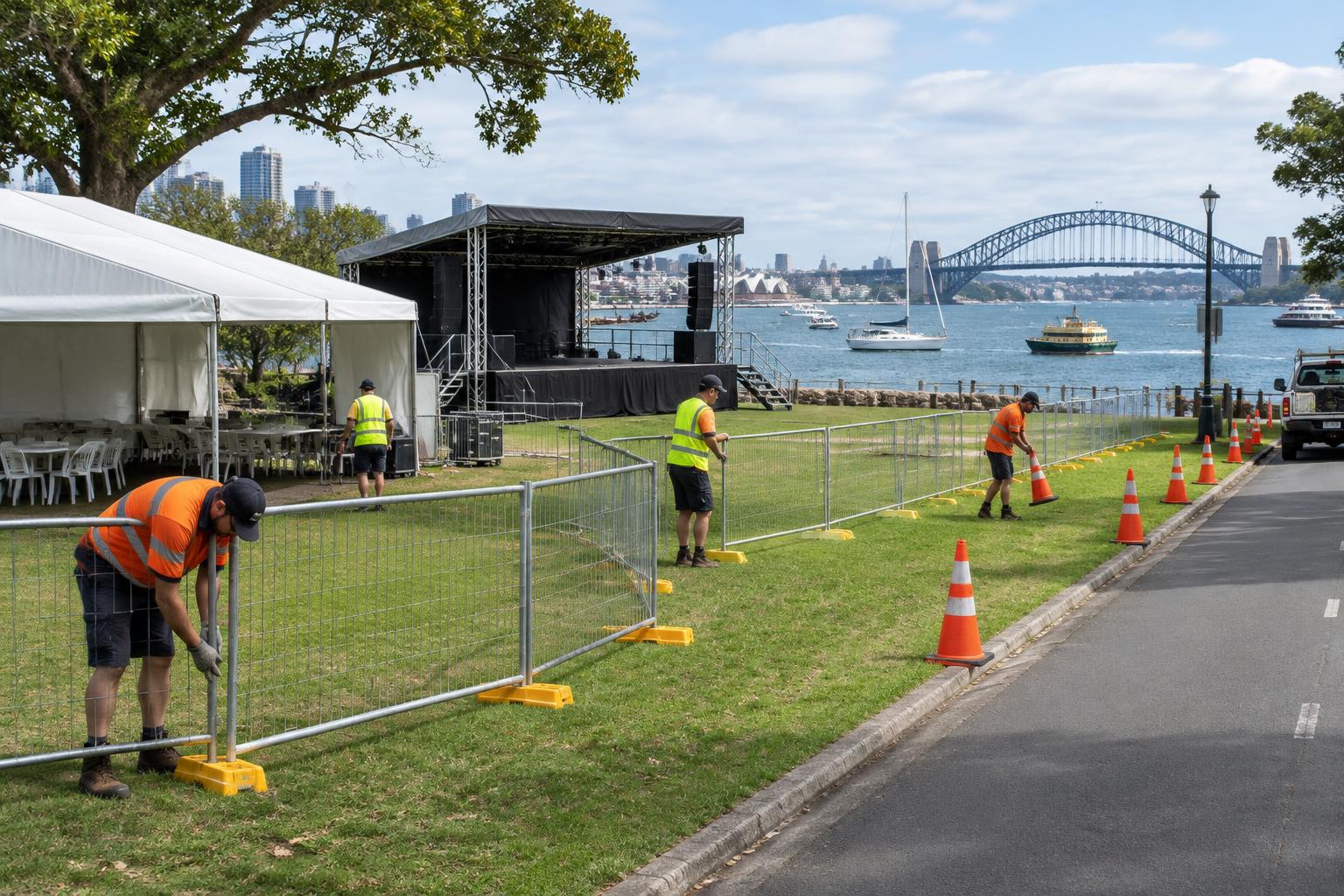
Imagine a brand launch with a marquee in a waterfront reserve, a temporary bar, delivery trucks using a nearby street and a product demonstration on the water. This is hypothetical—not an approved event or legal determination.
- Confirm the footprint. Establish the reserve’s authorised manager and the terms of site use, including setup and pack-down.
- Describe the road impact. Ask about loading, queues and any closure or traffic control—not simply whether the venue has parking.
- Resolve the bar’s authorisation. Confirm the licence holder and whether the proposed service is covered.
- Scope the water activity. Check with the maritime authority whether an aquatic licence is required and what supporting permissions it needs.
- Reconcile the plans. Make sure dates, boundaries, attendance and operating hours agree across the documents. Add further approvals for structures, food, noise or other activities where applicable.
The lesson is not that every launch needs five permits. It is that the activity and location determine the pathway—not the label “brand launch”.
05 / What agencies can do differently
Give the coordinator a decision trail
A shared approval register should capture more than a tick next to “council”. For each relevant activity, record:
- The authority, named contact and confirmed application pathway.
- The person responsible for preparing and submitting the documents.
- The authority’s confirmed lodgement deadline, separately from your internal target date.
- The plans and permissions that depend on another decision.
- The current status: enquiry, submitted, more information requested, or written approval received.
- The conditions that must flow through to suppliers, crew and the final site plan.
The useful question at the production meeting: “Which activity on our site plan is not yet covered by a confirmed permission or a documented next step?” That is more actionable than “Are the permits sorted?”
From research to paperwork
Start with your event’s approval triggers.
Event Permit Ready’s free checker identifies approvals that may apply to your answers. The optional $99 AUD detailed report adds an initial research plan, a risk assessment pre-filled with suggested hazards and typical controls, draft council and resident letters, and a private deadline tracker with optional email reminders after purchase.
Worksheets are editable starting points—not site-specific safety certification or completed applications. Tracker dates use indicative planning lead times; confirm actual deadlines with each authority. We do not submit applications or guarantee approval.
Working in Sydney? Explore the City of Sydney submission pack, or the event approval planning guide.
Independent editorial guidance from Event Permit Ready. Not affiliated with or endorsed by any authority. This briefing does not establish a universal percentage of approval effort, a guaranteed turnaround or an exhaustive national approval pathway.